The Cyclospora outbreak is over. The season it was hiding in is not.
On September 11, 2026, the CDC declared the Cyclospora outbreak linked to Taylor Farms de México iceberg lettuce over. The final count is 12,883 illnesses across 21 states, at least 570 hospitalizations and two deaths, both in Michigan. It is one of the largest foodborne outbreaks ever recorded in the United States. And it accounts for barely two-thirds of this year's cases. Over the same months, 19,883 people were confirmed with cyclosporiasis acquired inside the country — which leaves 7,000 illnesses with no named source at all.
Two counts, side by side
The named outbreak (iceberg lettuce, Taylor Farms de México): 12,883 illnesses, at least 570 hospitalizations, 2 deaths, 21 states. Illness onsets from June 14 to August 17, 2026. Recall initiated July 17. Declared over September 11.
The season (all domestically acquired cyclosporiasis, May 1 to August 31, 2026): 19,883 laboratory-confirmed cases, 1,064 hospitalizations, 2 deaths, across 49 states and the District of Columbia. The same window in 2025 produced 1,180 cases — a seventeen-fold difference.
What “over” actually means here
An outbreak is declared over when new cases tied to it stop appearing and the implicated food is gone from the supply. Both conditions were met, and the CDC is unusually specific about the shape of it: before the July 17 recall, the outbreak was producing more than 1,000 infections a day at its peak. By August it was averaging fewer than two a day.
That collapse is the strongest evidence anyone has that the traceback was right. A recall that removes the true vehicle stops an outbreak almost vertically; a recall that removes the wrong one does not. This one stopped.
“Over” does not mean the last case has been counted. Cyclosporiasis takes about a week to make someone ill, days more before they see a doctor, and weeks before a confirmed result reaches a national database. Cases from earlier in the summer are still being reported. The CDC moved to periodic rather than weekly updates on September 15 for exactly that reason: the flow has slowed to a trickle of backdated reports.
The 7,000 cases the outbreak does not explain
Subtract the outbreak from the season and 7,000 confirmed infections remain, along with up to 494 hospitalizations. They are not a mystery in the epidemiological sense — cyclosporiasis is seasonal in the United States every summer, and most cases never get linked to a specific food. But the scale is new. A normal season is on the order of a thousand cases nationally. This one produced nearly twenty thousand, and the single largest outbreak in it explains only 65 percent.
Geography makes the point sharply. The outbreak touched 21 states. The season touched 49 states and Washington, D.C. — effectively the whole country. Whatever else was circulating was not confined to one supplier's distribution map.
No public record identifies a source for those cases. That is an honest gap, not an evasion: linking a diffuse parasite to a specific food requires interviews, traceback and a cluster tight enough to analyse, and most of these cases have none of the three.
Why Cyclospora is hard to find in the first place
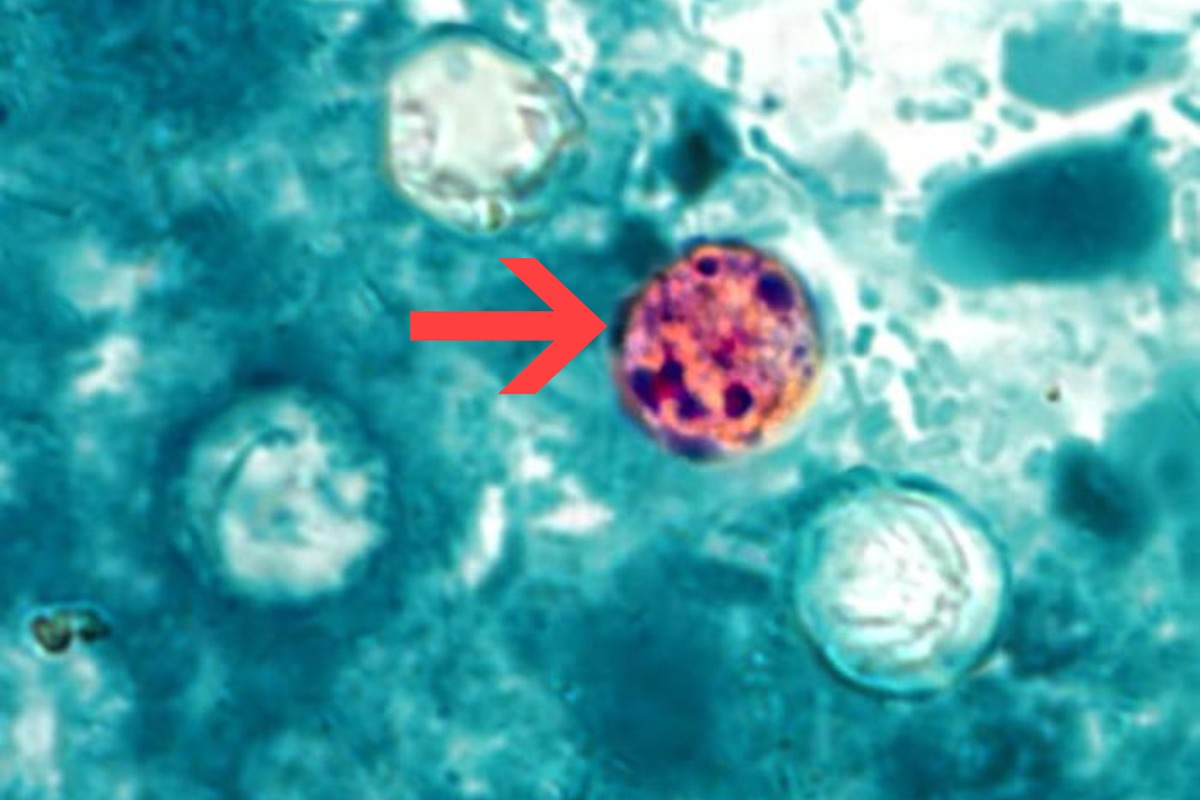
There is a detail in the CDC's July 14 health advisory that reframes every number above. Cyclospora is not reliably detected by a standard ova-and-parasite stool exam. Finding it requires a specific request: a modified acid-fast stain, or PCR. A clinician who orders the routine panel can get a clean result from a patient who is infected.
That is what the photograph at the top of this article shows — an oocyst that only becomes visible once someone has decided to look for it with the right stain.
The consequence runs in one direction only. Every figure here is a floor, not a ceiling. The 19,883 are the people who were tested, tested correctly, and confirmed. The advisory also asked clinicians to consider cyclosporiasis in anyone with prolonged watery diarrhea between May and August, and to take a food and travel history — a request that would not be necessary if the diagnosis were routinely being made.
It is worth remembering how the season looked from inside it. On July 14, the CDC counted 1,645 confirmed domestic cases with more than 5,100 awaiting confirmation, in 34 states, with no deaths. Nine weeks later the confirmed total was twelve times higher, the map covered nearly every state, and two people had died. The backlog was not noise. It was the outbreak, arriving late in the data.
What this changes for a shopper
Very little, and that is the uncomfortable part. Cyclospora is not destroyed by washing produce, and there is no consumer-level test. Cooking kills it, but the foods it travels on — lettuce, herbs, berries — are eaten raw by definition.
What does help is knowing the symptom that distinguishes it: watery diarrhea that does not resolve, often lasting weeks, sometimes relapsing, frequently with fatigue and loss of appetite. It is treatable — trimethoprim-sulfamethoxazole for seven to ten days — but only once diagnosed, and diagnosis requires the specific test. A patient who mentions the word, and who mentions salad, changes what gets ordered.
What to do
There is no product to check: the recalled lettuce left the supply chain in July and this outbreak is closed. If you had prolonged watery diarrhea this summer that was never explained, it is worth raising with a doctor — Cyclospora infections can relapse, and the standard stool test does not reliably detect the parasite. Ask specifically whether a Cyclospora test was done. If you are ill now with diarrhea lasting more than a few days, say so early rather than waiting it out: the treatment is a short course of antibiotics, and it works.
Sources
- CDC — Investigation Update: Cyclospora Outbreak, July 2026 (final counts; outbreak declared over September 11, 2026): cdc.gov
- CDC — Cyclospora Case Data: 19,883 domestically acquired laboratory-confirmed cases and 1,064 hospitalizations, May 1 to August 31, 2026, in 49 states and DC; updated September 15, 2026: cdc.gov
- CDC — Health Alert Network advisory HAN00531, Domestically Acquired Cyclosporiasis Cases in Multiple U.S. States, July 14, 2026 (testing guidance and treatment): cdc.gov
- FDA — Investigation of Multistate Outbreak of Cyclospora Illnesses: Iceberg Lettuce (July 2026), traceback and recall: fda.gov
- CDC — Surveillance of Cyclosporiasis, on how cases are counted and reported: cdc.gov
Case counts, hospitalizations, deaths, dates and testing guidance come from the Centers for Disease Control and Prevention and the U.S. Food and Drug Administration. This article is independent consumer information; it is not affiliated with the CDC, the FDA or the companies named, whose names are used for identification purposes only. It is not medical advice — if you are unwell, consult a healthcare professional. The comparison between the outbreak count and the national seasonal count is Numeline's arithmetic on the two published figures.
Know before you eat
Numeline scans a product and checks it against official FDA and USDA recalls in real time — and flags allergens and foods to avoid for each member of your household. Free on iOS and Android.